
Question 1
Explain what is meant by the term ‘universe’.
Question 2
- What is the approximate age of the universe?
- What is the approximate size of the universe?
Question 3
Name the three main components of the universe.
Question 4
- Describe normal matter.
- Describe dark matter.
- Describe dark energy.
Question 5
- Explain why scientists believe dark matter exists, even though it has never been observed.
- Explain why scientists believe dark energy exists, even though it has never been observed.
Question 6
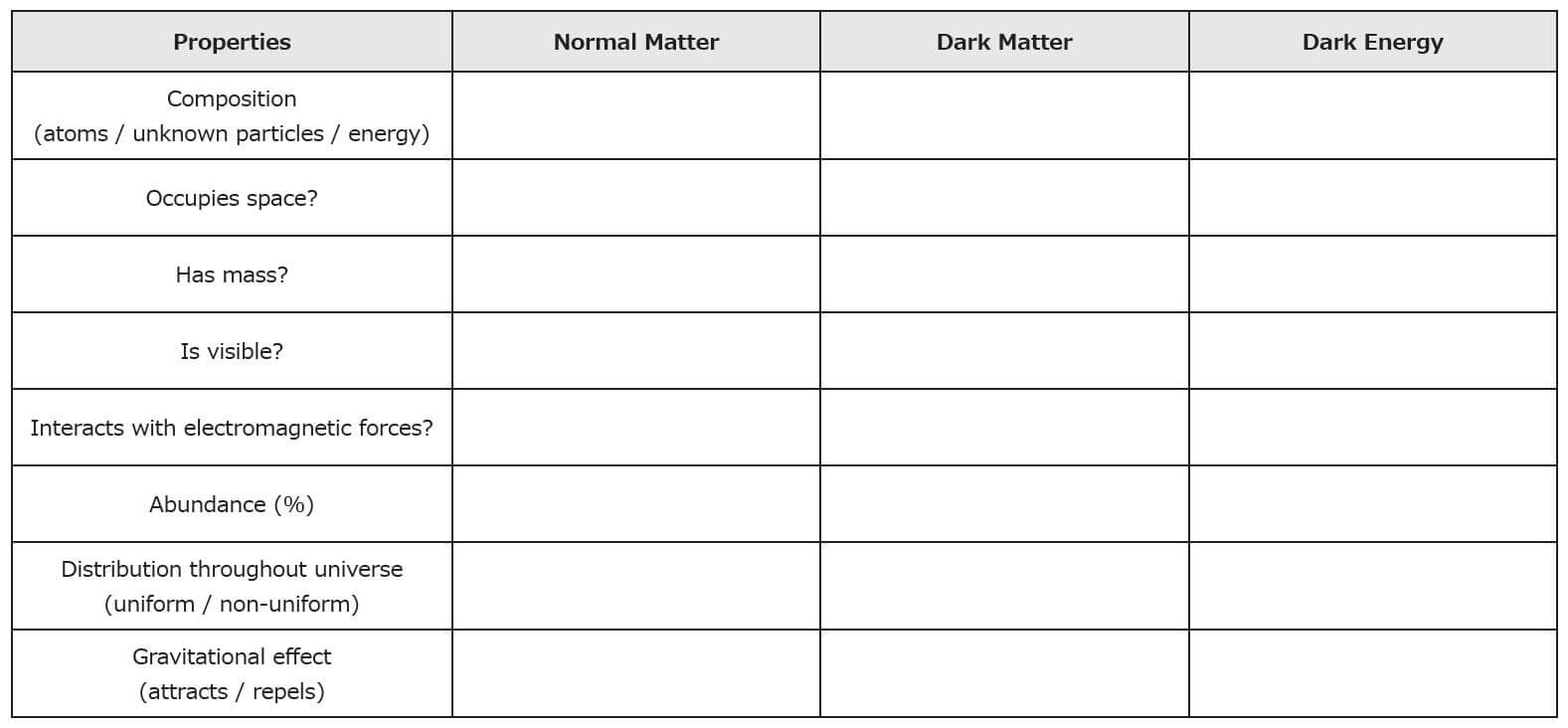
Complete the following table summarising normal matter, dark matter and dark energy.
Question 7
Differentiate between the terms ‘astronomical body’ and ‘astronomical object’, with examples.
Question 8
Describe the following astronomical bodies.
- Star
- Planet
- Dwarf planet
- Moon
- Asteroid
- Comet
- Meteoroid
Question 9
Describe the following astronomical objects.
- Planetary system
- Star system
- Star cluster
- Galaxy
Question 10
Compare the age and origin of stars within star systems, star clusters and galaxies.
Question 11
Describe the interstellar medium and the intergalactic medium.
Question 12
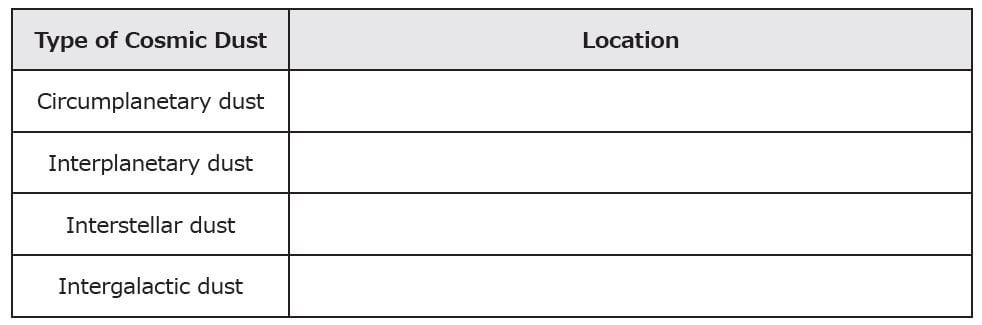
- Describe cosmic dust.
- Complete the following table by stating the location of each type of cosmic dust.
Question 13
- Describe nebulae.
- What is the significance of nebulae in the life cycle of stars?