
2 | Composition of the Universe
2 | Composition of the Universe
Composition of the Universe
- We learned in year 7 that matter is defined as anything that occupies space and has mass.
- All observable components of the universe, such as stars, planets and moons, are composed of matter.
- Yet scientists estimate that visible matter accounts for only about 5% of the universe.
- The remaining 95% is composed of dark matter (~27%) and dark energy (~68%).
- These mysterious components affect the size and shape of the universe, but cannot be observed directly. They are only known about by indirect evidence and scientists are still trying to determine their exact nature.
Normal Matter
- Normal matter (also known as baryonic matter, ordinary matter or visible matter) incorporates everything we normally understand by the term ‘matter’.
- It includes everything we can directly observe in visible light or using some other form of electromagnetic radiation, such as ultraviolet light or infrared light.
- Normal matter occupies space and has mass. It is made up of protons, neutrons, and electrons, and can exist as a solid, liquid or gas, or as plasma (ionised gas).
Dark Matter
- Dark matter is similar to normal matter in that it occupies space and has mass, but it doesn’t interact with electromagnetic forces like normal matter does.
- This means that:
- Dark matter doesn’t reflect, absorb, or emit any form of electromagnetic radiation, including light, making it invisible and not directly detectable.
- Dark matter passes through normal matter, meaning it cannot be touched, held in a container or weighed directly.
- Since it has mass, dark matter is believed to be composed of particles of an unknown type.
- The only reason that scientists believe dark matter exists is through its gravitational effects, which include its influence on the size and structure of the universe.
- Dark matter is believed to be unevenly distributed throughout the universe, forming a weblike ‘gravitational scaffold‘ holding galaxies together.
- Other than this, scientists are not exactly sure what dark matter is.
Dark Energy
- Dark energy is an unknown repulsive phenomenon that exists uniformly throughout the universe. Dark energy opposes gravitational force.
- Being a form of energy, dark energy doesn’t occupy space and doesn’t have mass. It also doesn’t interact with electromagnetic forces.
- Scientists believe dark energy exists as it explains the accelerating expansion of the universe.
- Yet, scientists understand dark energy even less than they do dark matter, and it remains one of the great mysteries in astrophysics and cosmology.
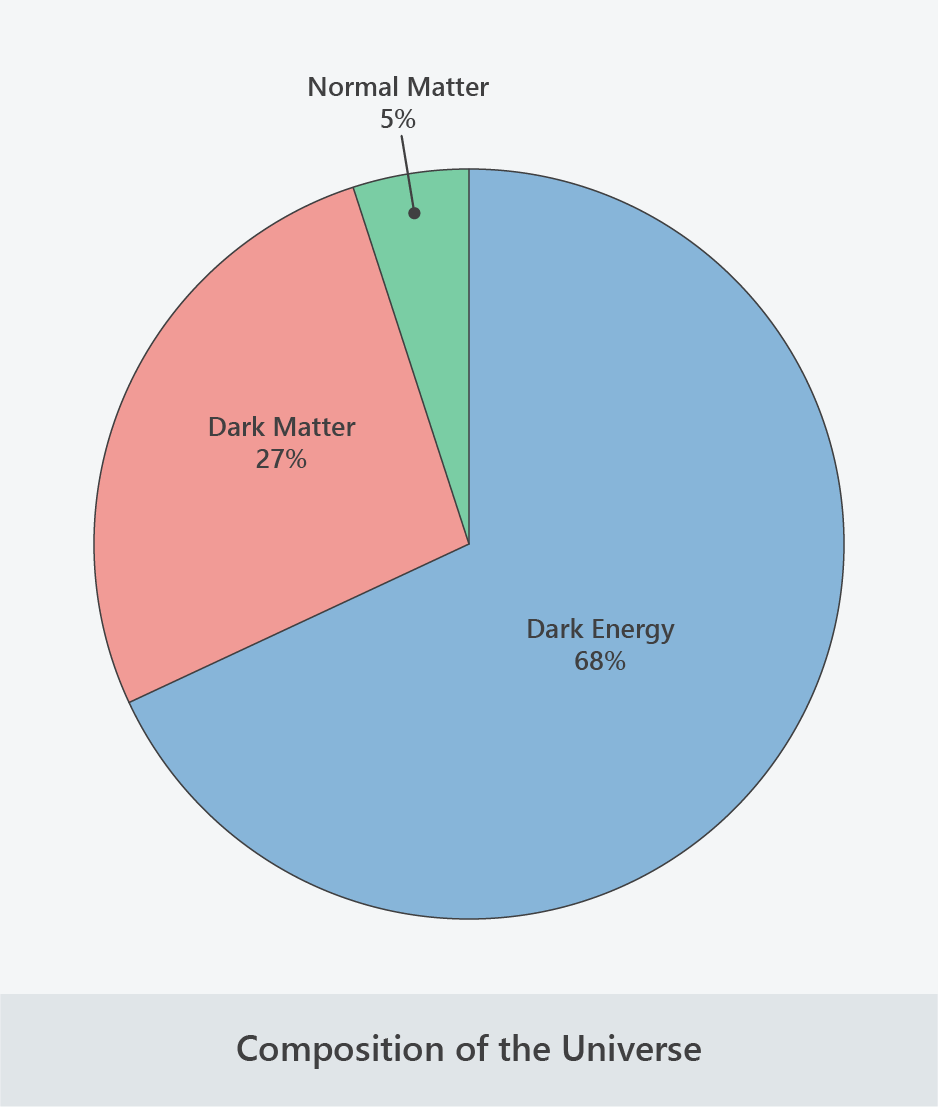
Normal matter only accounts for about 5% of the universe. The rest is composed of dark matter and dark energy.