
7 | Summary
8 | Summary
Summary
- The universe includes the entirety of space, matter, energy and time.
- It is composed of normal matter, dark matter and dark energy.
- Normal matter is made up of protons, neutrons, and electrons and includes everything that we can directly observe.
- It only accounts for about 5% of the universe.
- Dark matter is an unknown form of invisible matter that is only believed to exist due to its gravitational effects.
- It accounts for about 27% of the universe.
- Dark energy is an unknown form of energy that is believed to oppose gravitational force, causing accelerated expansion of the universe.
- It accounts for about 68% of the universe.
- An astronomical body is any single, naturally occurring entity that exists within the universe, including:
- Stars – large, luminous balls of hot gas undergoing nuclear fusion.
- Planets and dwarf planets – spherical bodies that orbit stars or stellar remnants.
- Moons – bodies that orbit planets or dwarf planets.
- Asteroids – small, irregularly shaped, rocky bodies that orbit stars.
- Comets – small, irregularly shaped bodies composed of ice and dust that orbit stars and which have distinct ‘tails’.
- Meteoroids – small fragments derived from asteroids or comets.
- An astronomical object is any gravitationally bound group of astronomical bodies, including:
- Planetary systems – systems consisting of a star or stellar remnant orbited by planets and other non-stellar bodies.
- Star systems – small groups of fewer than ten stars.
- Star clusters – medium-to-large groups of tens to thousands of stars.
- Galaxies – very large or extremely large groups of millions to trillions of stars.
- The interstellar medium and the intergalactic medium contain extremely low densities of gas and dust, but account for most of the visible matter in the universe.
- Cosmic dust refers to microscopic, solid particles that are interspersed between astronomical bodies.
- Nebulae are giant clouds of interstellar gas and dust.
- They are the remnants of dying or exploding stars and can become sites where new stars form.
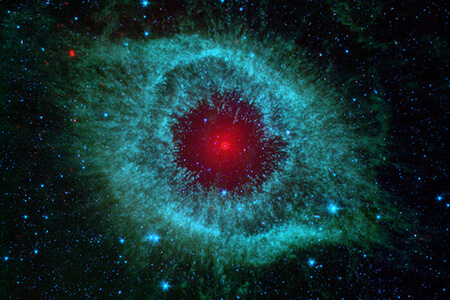
(Image: NASA)