

Question 1
Label the following statements as true (T) or false (F).
- Waves are caused by some type of vibration.
- Waves transfer energy.
- Waves transfer matter.
- All electromagnetic waves are transverse waves.
- Light is a type of electromagnetic wave.
- Sound is a type of electromagnetic wave.
Question 2
- Distinguish between a mechanical wave and an electromagnetic wave.
- Distinguish between a transverse wave and a longitudinal wave.
Question 3
- Give an example of a transverse mechanical wave.
- Give an example of a longitudinal mechanical wave.
- Give three examples of electromagnetic waves.
Question 4
- Explain how a sound wave can be generated from a guitar string.
- Explain why this sound wave cannot travel through a vacuum.
Question 5
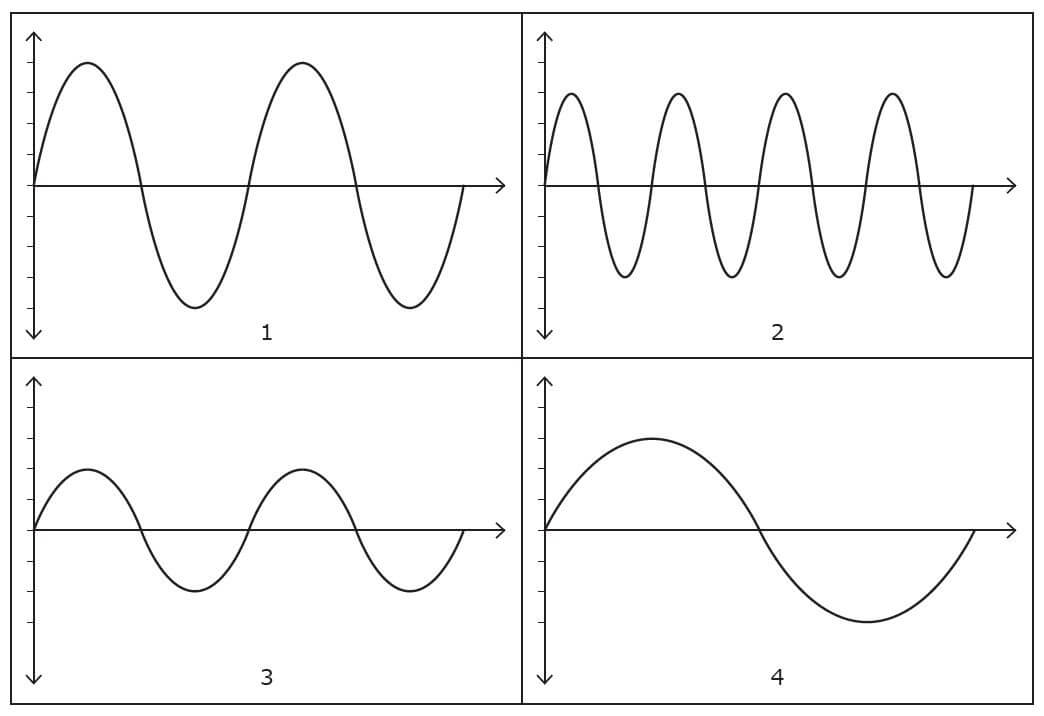
Assuming each axis has the same scale, which of the following waves has:
- The longest wavelength?
- The highest frequency?
- The greatest amplitude?
- The greatest velocity?
Questions 6 and 7
Click on the image below to download and print the following two questions.
Question 8
- Write the formula for calculating a wave’s velocity from its frequency and wavelength.
- Why is amplitude not included in the above formula?
Question 9
- Give the name and symbol of the unit for measuring the frequency of a wave.
- Describe in words what this unit means.
Question 10
- If a wave has a frequency of 256 Hz and a wavelength of 1.3 m, what would the new frequency of the wave be if its wavelength changed to 2.6 m (while its velocity remained constant)?
- If a wave has a wavelength of 75 m and a velocity of 1500 m/s, what would the new wavelength of the wave be if its velocity changed to 3000 m/s (while its frequency remained constant)?
Question 11
Show all working for the following questions.
- Calculate the velocity of a sound wave with a frequency of 2500 Hz and a wavelength of 1.4 m.
- Calculate the frequency of a sound wave with a wavelength of 6 m and a velocity of 1500 m/s.
- Calculate the wavelength of a sound wave travelling at 340 m/s with a frequency of 1000 Hz.