

Question 1
Explain what is meant when it is said that Earth’s axis is on a tilt.
Question 2
Explain what is meant by the terms ‘north celestial pole’ and ‘south celestial pole’.
Question 3
Draw a labelled diagram showing Earth’s tilt. In your diagram, include the following:
- Axis
- Equator
- Orbital plane (ecliptic plane)
- Angle of axial tilt
- North celestial pole
- South celestial pole
Question 4
What are the two main consequences of Earth’s axis being on a tilt?
Question 5
- Draw a diagram showing how one half of Earth experiences daylight while the other half experiences darkness.
- Explain why, at any given time, one hemisphere is always experiencing more daylight than the other.
- Compare the lengths of days and nights between the two hemispheres.
Question 6
- Describe the relationship between distance from the Equator and difference between day length and night length.
- Describe the relationship between distance from the Equator and variation in daylight hours throughout the year.
Question 7
Select the correct underlined options for the following statements.
- For a country in the Northern Hemisphere:
- People in the eastern / western part of the country will see the sunrise before people in the eastern / western part of the country.
- People in the northern / southern part of the country will see the sunrise before people who are directly north / south of them.
- People in the northern / southern / eastern / western part of the country will experience the greatest variation in day length throughout the year.
- For a country in the Southern Hemisphere:
- People in the eastern / western part of the country will see the sunrise before people in the eastern / western part of the country.
- People in the northern / southern part of the country will see the sunrise before people who are directly north / south of them.
- People in the northern / southern / eastern / western part of the country will experience the greatest variation in day length throughout the year.
Question 8
Explain how sunlight intensity varies depending on the location on Earth’s surface. Draw a diagram to illustrate your answer.
Question 9
- Describe how Earth’s tilt affects the hours of sunlight a particular point on Earth receives throughout the year.
- Describe how Earth’s tilt causes the seasons.
- Explain why the seasons are the opposite for the two hemispheres.
Question 10
- If Earth’s axis was not tilted, how would this affect the amount of sunlight a particular point on Earth received throughout the year?
- If Earth’s axis was not tilted, how would this affect the seasons?
Question 11
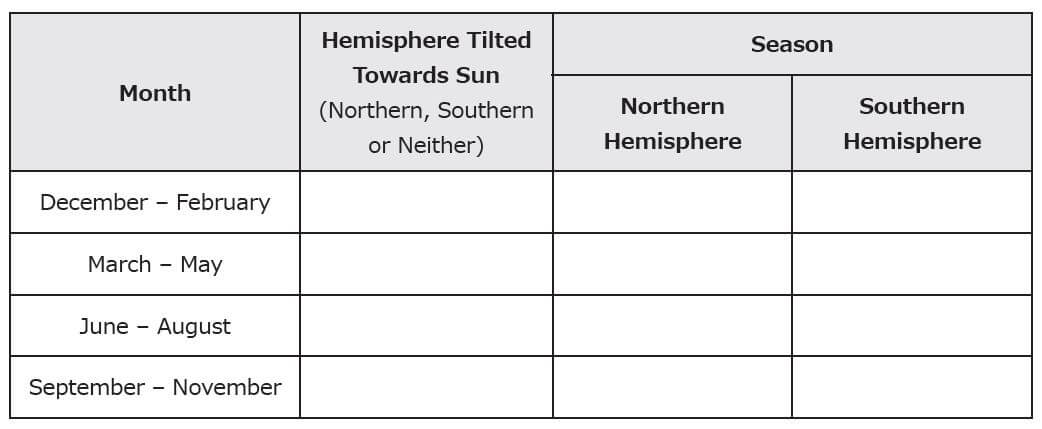
Complete the following table.
Question 12
Draw diagrams showing the orientation of Earth’s axis and the direction of the Sun’s rays when it is:
- Summer in the Northern Hemisphere.
- Summer in the Southern Hemisphere.
Question 13
Describe the relationship between season and day length.
Question 14
Describe the relationship between distance from the Equator and variation between seasons.
Question 15
Describe the seasonal variation for the following regions.
- Equatorial regions
- Mid-latitude regions
- Polar regions
Question 16
Use the diagram below to answer the following questions.
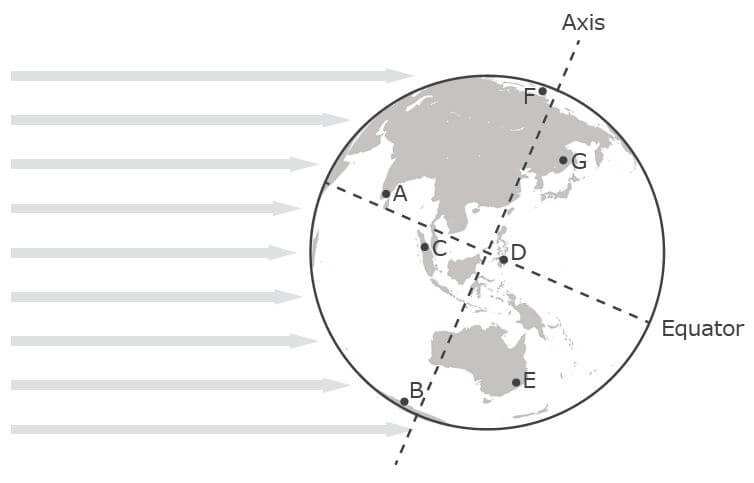
- Which locations are experiencing days that are longer than nights?
- Which locations are experiencing nights that are longer than days?
- Which location is experiencing days and nights of equal lengths?
- Rank all locations from those experiencing the longest day to those experiencing the shortest day.
- Which locations experience a wet season and a dry season?
- Which locations experience long winters and short summers?
- Which locations experience four distinct seasons of equivalent length?