
Question 1
What is the full name of DNA?
Question 2
What are the subunits of DNA molecules called?
Question 3
What are the three parts of DNA subunits?
Question 4
Draw a simple labelled diagram of a nucleotide.
Question 5
- Which part of a DNA nucleotide can vary?
- How many variations are there and what letters are used to indicate the different types?
Question 6
- How are DNA nucleotides joined to form a single strand of DNA – which parts are connected and what type of bond is involved?
- How are DNA nucleotides joined to form a double strand of DNA – which parts are connected and what type of bond is involved?
- Of the two types of bonds mentioned in parts (a) and (b), which type is stronger?
Question 7
Describe what is meant by ‘base-pairing rules’ in DNA.
Question 8
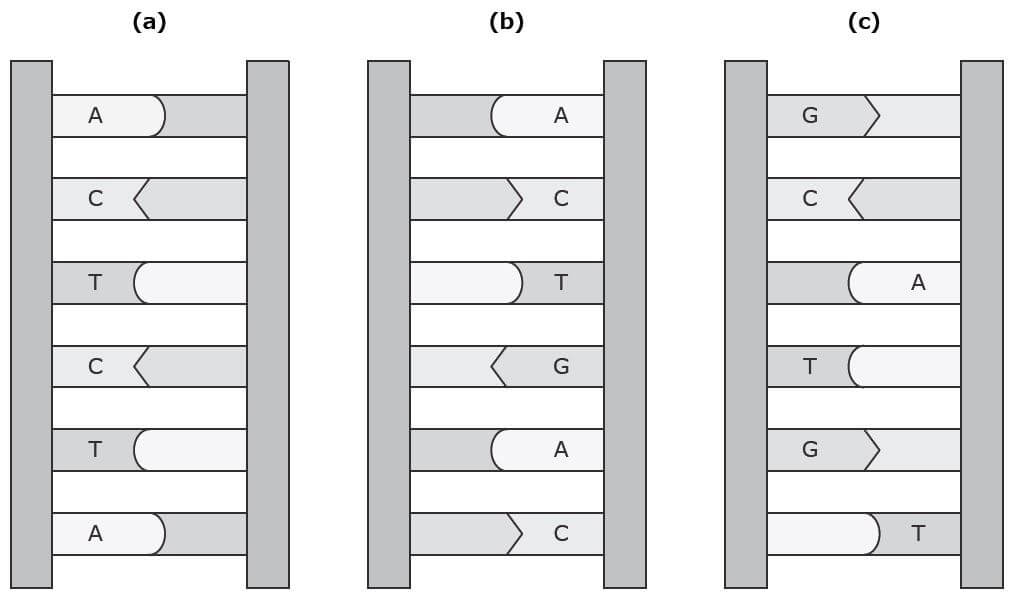
Use the base-pairing rules to complete the labelling of the bases in the following DNA molecules.
Question 9
Label the following statements as true (T) or false (F).
- DNA has the same general structure in all organisms.
- All the bases in DNA nucleotides are the same.
- All the sugars in DNA nucleotides are the same.
- Any two nucleotides of DNA can form a base pair.
- Any two nucleotides of DNA can form a covalent (phosphodiester) bond.
- The bases A and T always exist in equal proportions in a DNA molecule.
- The bases A and C always exist in equal proportions in a DNA molecule.
Question 10
- Name the specific shape formed by a double-stranded DNA molecule.
- This shape is sometimes described as a ‘twisted ladder’. In this analogy, which parts of DNA make up the ‘rails’ and which parts make up the ‘rungs’?
- What other term is sometimes used to describe the ‘rails’ of a DNA molecule?
Question 11
- What cell structures do DNA molecules form part of?
- Where are these structures located in cells?
Question 12
Explain how DNA molecules encode genetic information.
Question 13
Match the labels 1-7 on the following diagram with the correct term from the word list below.
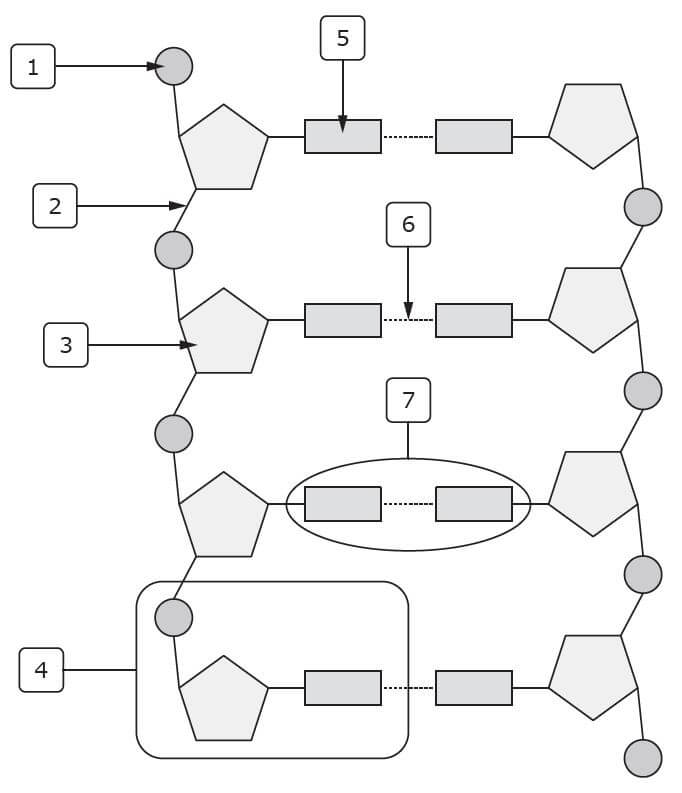
base • base pair • covalent bond • hydrogen bond • nucleotide • phosphate • sugar
Question 14
The table below shows DNA sequences from three different species.
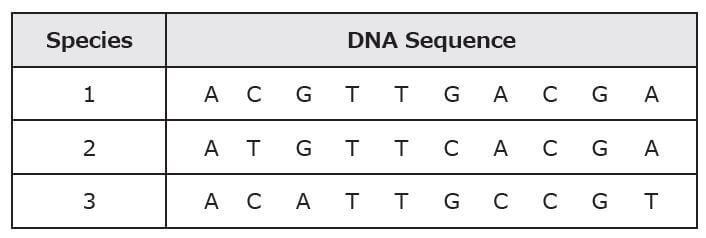
Calculate the genetic similarity, as a percentage, for the following pairs of species:
- 1 and 2
- 2 and 3
- 1 and 3