Sample answers for questions that are answered offline are shown below.
Question 2
Question 6
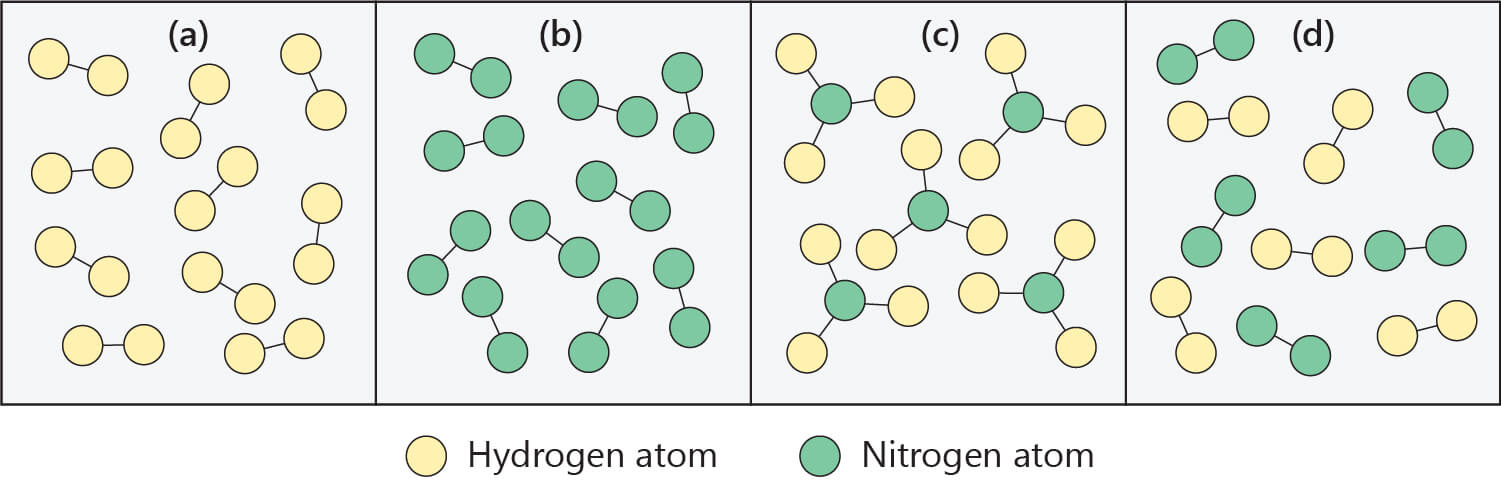
Answers for this question will vary – elements need to show one type of atom; compounds need to show one type of molecule containing more than one type of atom; mixtures need to show more than one type of subunit (atom or molecule).
Question 8
- Atoms and molecules are both building blocks of matter. An atom is the simplest type of building block. A molecule contains two or more different types of atoms, joined together in fixed arrangements by chemical bonds.
- Elements and compounds are both pure substances as they consist of only one type of particle. In elements, that particle is an atom or a molecule made up of one type of atom; in compounds, that particle is a molecule made up of more than one type of atom.
- An atom is the simplest building block of matter. An element is a substance that is made up of only one type of atom.
- A compound is a substance made up of one type of molecule, which contains two or more different types of atoms. It can only be separated into its constituent elements by chemical processes. A mixture is a combination of two or more pure substances (elements or compounds). It can be separated into its components by physical processes.
Question 9
- In a compound containing nitrogen and oxygen, the nitrogen and oxygen atoms are joined by chemical bonds. In a mixture containing nitrogen and oxygen, the nitrogen and oxygen atoms are not joined to each other. The compound contains one substance, with specific physical and chemical properties; the mixture contains two substances, each with their own physical and chemical properties.
- To separate the compound into elements, the chemical bonds between the atoms in the molecules need to be broken. Physical processes are unable to break chemical bonds; chemical processes are required.
Question 10
Molecules usually contain two or more different types of atoms, but sometimes they contain just one type. For example, the element oxygen is made up of molecules that contain two oxygen atoms chemically bonded together. Similarly, the elements hydrogen, nitrogen, fluorine, chlorine and bromine are made up of molecules containing pairs of the same atom.
Question 11
There are only 92 naturally occurring elements, and about 20 synthetic (man-made) elements. This directly reflects the number of different types of atoms, which is limited (due to size and stability). Since molecules can contain combinations of these atoms, the number of molecules – and therefore compounds – is almost infinite.