

Question 1
- Distinguish between a scalar quantity and a vector quantity.
- Give three examples of scalar quantities.
- Give three examples of vector quantities.
Question 2
- Distinguish between distance and displacement.
- Describe a situation where an object’s displacement is equal to the distance it travelled.
- Describe a situation where an object has moved but its displacement is zero.
- Explain why the distance an object travels can never be less than its displacement.
Question 3
Calculate the distances travelled by cars that drove the following courses if each grid space represents 1 km × 1 km.
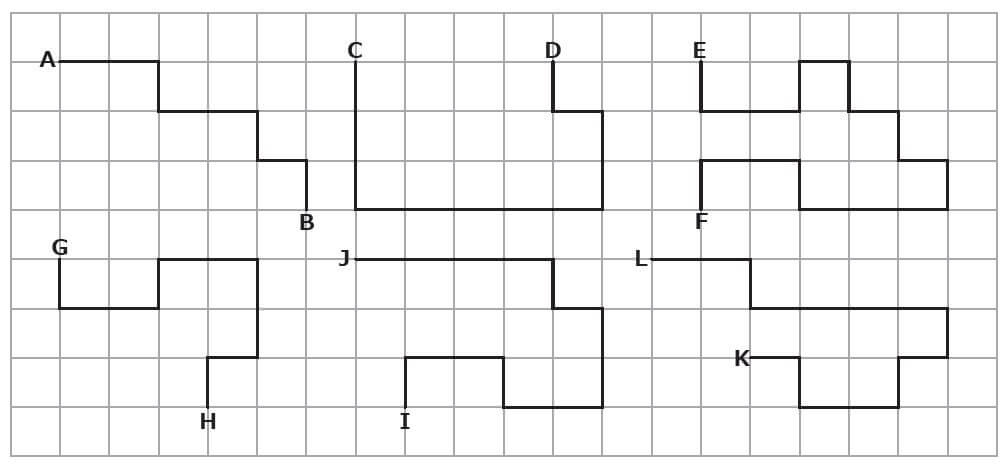
- A to B
- C to D
- E to F
- G to H
- I to J
- K to L
Question 4
Calculate the displacement of cars that travelled the following courses in question 3. Include a direction in your answer (eg N, NW etc). For (c) and (d), you will need to use the Pythagorean theorem shown below – give these answers to 1 decimal place.
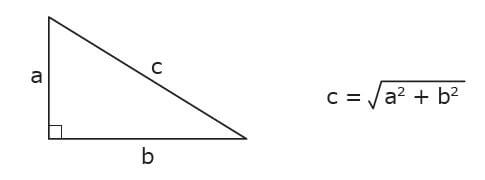
- C to D
- E to F
- G to H
- K to L
Question 5
- Define ‘speed’.
- Write the formula for calculating the average speed of an object based on the distance travelled and the time taken.
- Write the formula for calculating the distance an object travelled based on its average speed and the time taken.
- Write the formula for calculating the time taken for an object to move a specified distance based on a given average speed.
Question 6
Calculate average speed for the following situations. Show your working and include the correct units.
- Distance travelled = 100 m and time taken = 16 s.
- Distance travelled = 920 km and time taken = 10 hr.
- Distance travelled = 2.1 km and time taken = 3.0 s.
Question 7
Calculate distance travelled for the following situations. Show your working and include the correct units.
- Average speed = 1.6 m/s and time taken = 60 s.
- Average speed = 90 km/h and time taken = 2.5 hr.
- Average speed = 7.8 km/s and time taken = 90 s.
Question 8
Calculate time taken for the following situations. Show your working and include the correct units.
- Distance travelled = 100 m and average speed = 1.6 m/s.
- Distance travelled = 120 km and average speed = 50 km/h.
- Distance travelled = 4.5 km and average speed = 0.30 km/s.
Question 9
- Explain how to convert speed in km/h to speed in m/s.
- Explain how to convert speed in m/s to speed in km/h.
- Draw a diagram that summarises your answers to (a) and (b).
Question 10
- Convert 72 km/h to m/s.
- Convert 450 km/h to m/s.
- Convert 50 m/s to km/h.
- Convert 340 m/s to km/h.
Question 11
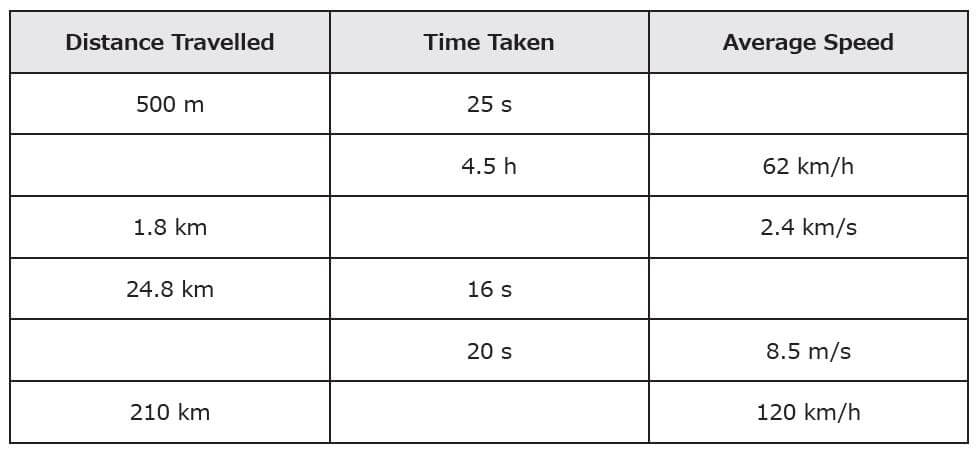
Complete the following table.
Question 12
For the following questions give your answers to 1 decimal place.
- The world record for the men’s 100m sprint is 9.58 s. Calculate the average speed.
- A student cycled at 13.5 km/h for 1.1 hr. How far did she travel?
- Sound travels at 0.34 km/s. How long will it take a sound wave to travel 2.5 km?
Question 13
- A whale swam 44,100 m in 2.4 h. What was its average speed in km/h? Give your answer to 1 decimal place.
- A student ran an 800 m race in 2 m 12 s. What was her average speed in m/s? Give your answer to 1 decimal place.
- A paint ball travelled at an average speed of 234 km/h for 1.65 s before hitting its target. How many metres away was the target? Give your answer to the nearest metre.
- A car travelled from Sydney to Brisbane in 11 h 15 min. If its average speed was 81.5 km/h, what is the distance between Sydney and Brisbane? Give your answer to the nearest kilometre.
- A bullet travelled 1.15 km at an average speed of 730 m/s. How many seconds did it take to hit its target? Give your answer to 2 decimal places.
- A car was travelling at 90 km/h when a truck pulled out in front of it. If the car travelled for 16.6 m before the driver hit the brakes, what was the driver’s reaction time in seconds? Give your answer to 2 decimal places.